
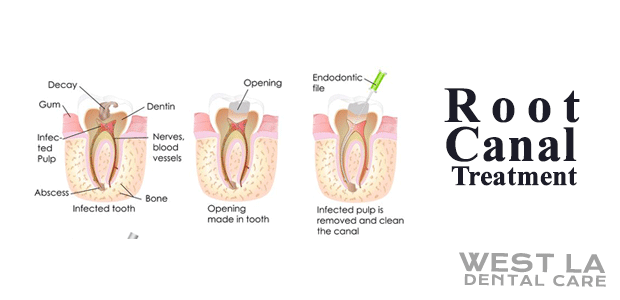
 Root Canal Treatment, Endodontics Therapy
Today we may have suggested to you that Root Canal Treatment (otherwise known as Endodontics Therapy) was needed for a particular tooth. We may have briefly discussed some of the facts concerning the procedures involved in root canal treatment but perhaps you would like some more information. Extraction is truly our last resort!
Contact West LA Dental Care Now!
 Why Us?
At West LA Dental Care, we go great lengths to provide quality. In our Dental Health Blog, we are posting weekly helpful tips for maintaining and keeping your oral and dental health, we also post about common issues and problems one may have in his life to keep his beautiful smile. You will find information about West LA Dental Care practice philosophy, the dentists, Santa Monica office location, insurance policies, and appointment scheduling procedures.
How To Find Us!What We Have to Care About?
Why Root Canal?
Root canal treatment is necessary when the pulp (soft tissue inside your teeth containing blood vessels, nerves and connective tissue) becomes inflamed or diseased. During root canal treatment, your dentist or endodontist (a dentist who specializes in treating the insides of teeth) removes the diseased pulp.
The pulp chamber and root canal(s) of the tooth are then cleaned and sealed. If the infected pulp is not removed, pain and swelling can result, and your tooth may have to be removed.
Causes of an infected pulp could include:
A deep cavityAepeated dental procedures
A cracked or broken tooth
Injury to the tooth (even if there’s not a visible crack or chip)
If you continue to care for your teeth and gums your restored tooth could last a lifetime. However, regular checkups are necessary; a tooth without its nerve can still develop cavities or gum disease. Most of the time, a root canal is a relatively simple procedure with little or no discomfort involving one to three visits. Best of all, it can save your tooth and your smile.
Root Canal Treatment Process
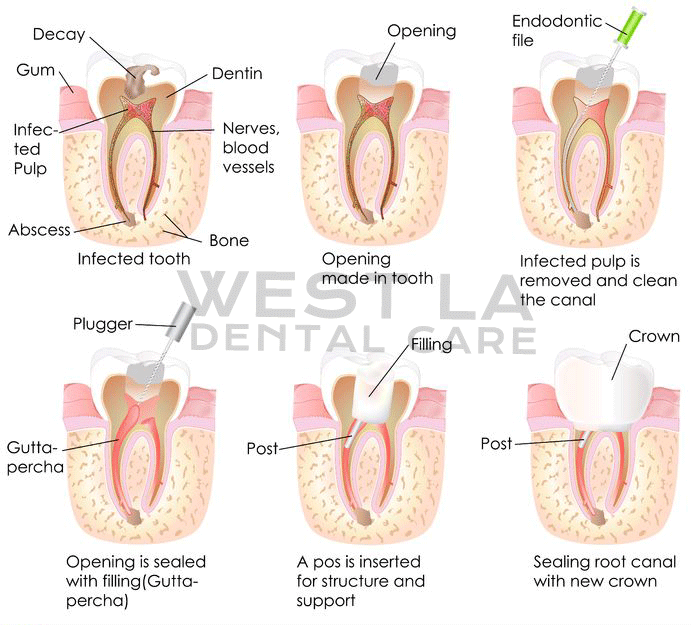
- Root canal treatment starts with the removal of the infected or irritated nerve tissue that lies within the root of the tooth. It is this infected pulp tissue that causes an eventual abscess.
- The first step in a root canal is to obtain access to the nerve. This is accomplished by establishing a small access opening in the top of the tooth. It will be done under a local anesthetic.
- Healed infection.
- At the same visit, the canal where the nerve is located will be reshaped and prepared to accept a special root canal filling material. This filling procedure will probably not occur until your next visit for the root canal treatment. The number of visits necessary to complete your root canal will depend upon several factors including the number of nerves in the tooth, the infected state of the nerve and the complexity of the procedure.
- The final step in your root canal treatment will be the sealing of the root canal with a sterile, plastic material, called gutta percha. This is done in order to prevent possible future infection.
- The tooth will then possibly need a post and core and a crown in order to re-establish normal form and function.
- This decision will be based upon several additional factors.
Root Canal Treatment Truths and Myths
If treated early, root canal treatment need not to be uncomfortable. With the use of local anesthetics, the entire procedure can be totally painless.
Myth:
By removing the nerve in root canal treatment the tooth becomes “dead”. This is not true. The truth is very much alive and functioning because it receives a source of blood supply and nerve supply from the surrounding tissues that hold it in place in your jaw bone. The tooth will have no sense of feeling to hot, cold or sweets but will be responsive to biting pressures, etc. With the proper restoration the tooth should last as long as your other teeth and can even be used as an anchor tooth for a partial denture or cemented bridge. The success rates for root canal therapy have been reported to be as high as 95%.
Truth:
Sometimes when there has been log standing infection or abscess, there may be some soreness associated with the first or second root canal visit. If this should turn out to be true you will be given specific instructions to follow to minimize the discomfort. When an infection is present, it may be necessary to take an antibiotic. If pain should be present, analgesics may need to be prescribed. In either case, be sure to all the office if either of these problems should arise.
What Else Do You Want?

Who We Are?
Dentistry in West Los Angeles and Santa MonicaWest LA Dental is something of a rarity among Los Angeles Dentists in that our practice has managed to grow each and every year, adding more and more new services we can offer to our patients, but without sacrificing either our founding commitment to excellence or our devotion to one to one more..
Dr. Afshin Golyad DDS
Preventative Dentistry and Cosmetic Care
Payment and Financing Options
Project ManagerWe accept checks, cash, VISA or MC, and CareCredit®. CareCredit® is available for a financing option, CareCredit® is specifically designed to finance medical procedures, particularly those not usually covered by insurance. You can apply for CareCredit® here.